


Goethe-Zertifikat vs. TELC: Which Official German Exam Should You Take?
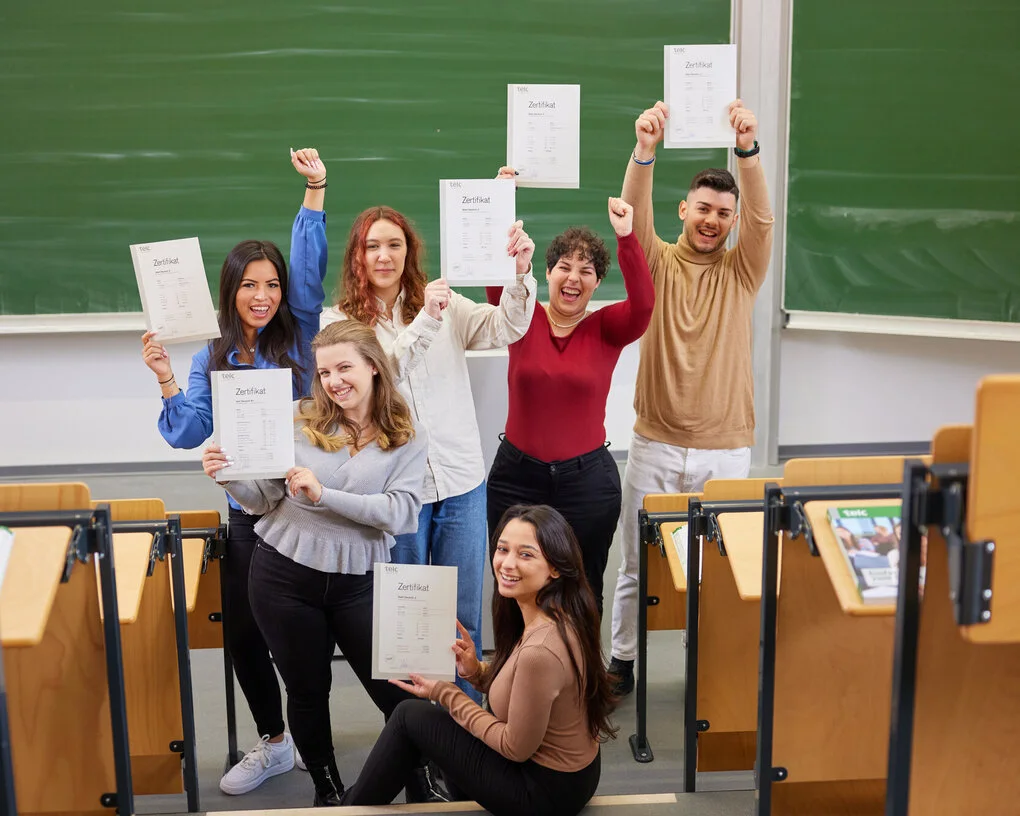
If you need an official German language certificate, both Goethe-Zertifikat and TELC are recognised options, but the right choice depends on why you need the certificate. Goethe offers a clear general German pathway from A1 to C2, while TELC offers both general German exams and several specialised options for work, university, nursing, and medicine. Before registering, always check which certificate your employer, university, or authority accepts. At Sprachschule Unter der Eiche, we often meet learners who are unsure which exam is the better fit. Both systems follow the Common European Framework of Reference for Languages (CEFR) and are designed to prove your German level officially. The key question is therefore not simply which exam is better, but which exam best matches your goal. What Is the Goethe-Zertifikat? The Goethe-Zertifikat is the official German language qualification offered by the Goethe-Institut. Goethe provides exams from A1 for beginners through C2 for highly proficient speakers, with standardised examinations available internationally. Goethe certificates can be used as proof of German language ability for purposes such as: visa or residence-related applications employment professional recognition university admission personal proof of German proficiency From B1 to C2, Goethe exams are modular, which means the reading, listening, writing, and speaking modules can be taken individually or together. For higher education, Goethe states that the Goethe-Zertifikat C2 is accepted by all German universities as proof of German proficiency. Some universities may also accept Goethe B2 or C1, depending on the programme and their individual requirements. What Is TELC? TELC stands for The European Language Certificates. Like Goethe, TELC exams are based on CEFR levels and provide recognised proof of your German proficiency. One of TELC’s main strengths is the variety of examinations available. Alongside general German qualifications, TELC offers specialised exams for specific academic and professional purposes, including: TELC Deutsch B1+ Beruf TELC Deutsch B2+ Beruf TELC Deutsch B1–B2 Pflege TELC Deutsch B2–C1 Medizin TELC Deutsch C1 Beruf TELC Deutsch C1 Hochschule TELC states that its certificates are recognised by schools, universities, employers, and authorities as proof of language proficiency. It also operates through thousands of examination centres worldwide. This wider selection makes TELC particularly useful if you already know that you need German for a specific professional or academic pathway. Goethe vs. TELC: What Is the Main Difference? The biggest difference is not the CEFR level. A B1, B2, or C1 exam is still designed to test language ability at that level. The main difference is how the two exam systems are structured and positioned. Goethe-Zertifikat provides a straightforward general German pathway from A1 to C2 and has a particularly strong international profile. It is commonly used as general proof of German language ability for study, work, visas, and personal purposes. TELC also offers general German exams, but it provides more purpose-specific qualifications. If you need a certificate for university, a professional pathway, nursing, medicine, or workplace German, there may be a TELC exam designed specifically for that situation. So your decision should start with the purpose of the certificate, not with which brand name you recognise more easily. Which Exam Is Better for Working in Germany? If you need German for work, either certificate may be suitable depending on what your employer or profession requires. A general Goethe B1 or B2 certificate can demonstrate your German level to an employer. TELC also offers general B1 and B2 qualifications, but it additionally provides professional exams such as B1+ Beruf, B2+ Beruf, and C1 Beruf, along with specialist examinations for healthcare professions. This can make TELC especially practical if your language requirement is directly connected to a professional field. However, you should never assume that one certificate will automatically satisfy every employer or professional authority. If you work in a regulated profession, the responsible authority may specify exactly which exam or language level it requires. Which Exam Is Better for University Study? If your goal is university study in Germany, check your target university’s language requirements before booking either exam. TELC offers TELC Deutsch C1 Hochschule, which is specifically designed for university entrance and academic German. Goethe states that the Goethe-Zertifikat C2 is accepted by all German universities as proof of language proficiency, while some institutions may also accept Goethe B2 or C1. The important point is that universities can set their own admission requirements. Uni-assist advises applicants to check directly which language certificates and levels are accepted by their chosen university or programme. So if university is your goal, the best exam is the one your specific institution accepts. Are Goethe and TELC Accepted Everywhere? Not necessarily. Both are recognised German language qualifications, but recognised does not mean universally accepted for every purpose. One employer may accept both Goethe and TELC. Another may not ask for a certificate at all and instead assess your German during the interview. One university may accept TELC C1 Hochschule, while another may request TestDaF, DSH, Goethe, or another recognised qualification. The same applies to professional recognition and official procedures. Requirements can vary depending on the institution, occupation, and purpose. This is why we strongly recommend checking the exact requirement before you pay for an exam. Doing so can save you time, money, and the frustration of preparing for a certificate that does not match your actual goal. Is Goethe or TELC Easier? There is no reliable answer that applies to everyone. Both Goethe and TELC are standardised examinations aligned with CEFR levels. If you take a B2 exam, for example, you are expected to demonstrate B2-level German regardless of which provider you choose. What can differ is the exam format and task style. You may personally find one exam easier to navigate because its speaking, writing, reading, or listening tasks suit the way you have prepared. For this reason, it is useful to look at official practice materials from both providers before deciding. Familiarising yourself with the task types can help you understand which format feels more comfortable. But exam familiarity should always
German Language School vs. Self-Study Apps: Which Gets You Fluent Faster?

If your goal is to become fluent in German as efficiently as possible, a German language school will usually help you progress faster than relying on self-study apps alone. Apps are useful for vocabulary, repetition, and flexible practice, but structured lessons give you something apps struggle to provide: real speaking practice, immediate correction, guided progression, and support from an experienced teacher. At Sprachschule Unter der Eiche, we see self-study tools as useful supplements, not complete replacements for teaching. You can certainly build knowledge on your own, but becoming confident enough to use German naturally in everyday life, work, study, or an exam usually requires more than completing exercises on a screen. German Language School vs. Self-Study Apps: What Is the Real Difference? The biggest difference is not simply whether you learn online or in a classroom. It is whether you are learning alone or learning with guidance. Self-study apps normally give you pre-set lessons, vocabulary exercises, grammar explanations, and automated corrections. You decide when to study and how quickly to move forward. A German language school gives you a structured curriculum, real teacher support, speaking interaction, correction, and clear progression from one level to the next. At Sprachschule Unter der Eiche, our German courses follow CEFR levels from A1 to C1, helping you develop speaking, listening, reading, and writing in a more balanced way. That structure becomes especially valuable when you have a clear goal, such as reaching B1 for everyday independence, improving your German for work, or progressing towards B2 or C1. Where Self-Study Apps Are Useful? Self-study apps can still play an important role in your learning. They are especially useful for: reviewing vocabulary practising short grammar exercises repeating common phrases building a daily study habit fitting German practice around a busy schedule Because lessons are usually short, apps make it easy to practise for a few minutes during your commute, lunch break, or evening. They can also be useful after class. For example, if you have just learned a new grammar topic or vocabulary set, an app can help you reinforce what you already studied. The problem starts when an app becomes your only teacher. Why Apps Alone Can Limit Your Progress? Learning a language is not the same as memorising facts. You need to use the language, make mistakes, receive feedback, and adjust. An app may tell you that an answer is wrong, but it cannot always explain why you keep making the same mistake or how that mistake affects your overall communication. Pronunciation is another challenge. You may know hundreds of German words but still struggle to be understood in real conversation if you have not received meaningful feedback. German grammar can also become increasingly complex as you progress. Word order, grammatical gender, cases, verb placement, and sentence structure all require more than simple repetition. Without proper guidance, it is easy to develop habits that become harder to correct later. This is where learning with a real teacher becomes much more valuable. Real Speaking Practice Changes Everything One of the clearest differences between self-study and language-school learning appears when you start speaking. You can complete hundreds of app exercises and still freeze when someone asks you a simple question in German. That happens because real conversation requires you to listen, understand, formulate a response, and speak — all in real time. A German language course gives you regular opportunities to practise exactly that. You can ask questions, join conversations, respond to classmates, and receive immediate correction. As you move through the CEFR levels, your speaking ability develops naturally. At A1, you begin with simple everyday communication. By B1 and B2, you are expected to express opinions, describe experiences, and communicate much more independently. This kind of interaction is difficult to reproduce through self-study alone. Structured Learning Helps You Avoid Gaps Another problem with self-study is that you naturally spend more time on what you enjoy and avoid what you find difficult. You may become strong in vocabulary but weak in listening. You might understand grammar exercises but struggle with writing. Or you may read German reasonably well while avoiding speaking completely. A structured language programme prevents this by developing all four core skills together: speaking listening reading writing At Sprachschule Unter der Eiche, our courses follow a clear CEFR pathway, so you know what you should be able to do at each stage and what skills you need to develop next. Instead of jumping randomly between apps, videos, and worksheets, you follow a more organised learning path. Which Option Gets You Fluent Faster? There is no single timeline that guarantees German fluency. Your progress depends on your starting level, how often you study, how much German you use outside lessons, and how consistently you practise. But if your priority is faster and more reliable progress, structured language-school learning usually has the advantage. The strongest approach is often to combine both methods: use your language course as the foundation use apps and self-study tools for extra revision and repetition For example, you might learn a new grammar structure in class, practise it through speaking and writing with teacher feedback, and then use an app later to reinforce vocabulary and sentence patterns. That way, self-study supports your learning instead of replacing the parts that require real interaction. When Is a German Language School the Better Choice? Self-study can be enough if you are learning casually, preparing for a holiday, or simply want to pick up some basic German with no deadline. A language school becomes far more valuable when you have a serious goal, such as: living in Germany communicating confidently in everyday life improving your German for work studying or completing vocational training reaching a specific CEFR level preparing for a recognised language exam At Sprachschule Unter der Eiche, our German courses are designed around these kinds of practical goals, with structured learning from beginner to advanced levels and support for learners who need German for daily
German C1 Exam Preparation: What to Study for the TELC Exam?
If you are preparing for the TELC German C1 exam, your study should focus on reading, language elements, listening, writing, and speaking. At C1 level, you are expected to express yourself spontaneously and fluently, adapt your style appropriately, and maintain a high level of grammatical accuracy. The TELC C1 exam includes both a written and an oral examination, so your preparation needs to be structured, balanced, and closely aligned with the official format. At Sprachschule Unter der Eiche, we recommend preparing with two goals in mind: strengthening your advanced German and becoming fully familiar with the TELC exam structure. At this level, it is not enough to simply know advanced vocabulary or grammar. You need to use German accurately, flexibly, and appropriately in demanding written and spoken situations. What Does the TELC German C1 Exam Cover? Understanding the structure is one of the first steps in effective C1 German exam preparation. According to TELC, the written examination includes: Reading – 3 parts Language Elements – 1 part Reading and Language Elements together – 90 minutes 20-minute break Listening – 3 parts, approximately 40 minutes Writing – 1 part, 70 minutes The oral examination includes: Speaking – 3 parts, approximately 16 minutes usually 2 participants 20 minutes of preparation time. TELC assesses receptive skills through reading, listening, and language elements, while productive skills are assessed through writing and speaking. TELC also states that the oral examination places particular emphasis on the direct exchange between test takers. What to Study for Reading and Language Elements? At C1, you need to work confidently with longer and more complex German texts. TELC uses receptive task types such as multiple-choice questions and matching tasks, so your preparation should focus on understanding overall meaning, recognising key details, and following relationships between ideas. We recommend practising with advanced German materials such as: newspaper and magazine articles opinion pieces reports formal and professional texts texts on society, education, culture, and current topics These are our recommended preparation materials rather than guaranteed TELC task types, but they can help you build the reading stamina and vocabulary range needed at C1. For the Language Elements section, focus on grammar and vocabulary in context. Useful areas to revise include advanced sentence structure, connectors, verb forms, register, idiomatic expressions, and stylistic accuracy. At C1, grammar is not only about being correct. It is also about choosing language that sounds precise and appropriate for the situation. What to Study for the Listening Section? The TELC C1 listening section has three parts and lasts approximately 40 minutes. To prepare effectively, you should regularly listen to advanced German and train yourself to follow complex spoken information without relying on word-for-word translation. Useful practice material can include: interviews discussions podcasts reports presentations natural spoken German Again, these are preparation recommendations rather than guaranteed exam task types. As you listen, practise identifying the main message, important supporting points, the speaker’s position, and how ideas develop throughout the audio. What to Study for the Writing Section? The TELC C1 writing section consists of one part lasting 70 minutes. TELC provides input that you must respond to in written form. At this level, your writing should show a high degree of control over structure, grammar, vocabulary, and register. During your preparation, practise how to: analyse the task carefully organise complex ideas logically develop and support arguments use appropriate linking expressions maintain a suitable register vary sentence structure check grammar, vocabulary, and style Strong C1 writing should be clear and precise. You do not need to make every sentence complicated. What matters is that your response is well structured, relevant to the task, and linguistically accurate. What to Study for the Speaking Section? The TELC C1 speaking exam has three parts, lasts approximately 16 minutes, and is usually completed with another participant. You receive 20 minutes of preparation time beforehand. TELC states that at C1 you should be able to express yourself spontaneously and fluently, use colloquial expressions, adapt your style deliberately, and maintain a high level of grammatical correctness. To prepare well, practise how to: present complex ideas clearly develop and justify arguments explain your position in detail respond naturally to another person’s viewpoint compare different perspectives adjust your language to the situation keep a discussion moving without relying on memorised answers Because TELC places strong emphasis on direct interaction, real speaking practice is especially important. You need to listen carefully, respond appropriately, and develop the conversation together rather than simply deliver a prepared speech. Vocabulary and Grammar to Revise for C1 Your C1 German exam preparation should help you build both range and precision. Useful vocabulary areas to revise include: work and education society and culture media and technology health and lifestyle environment and social issues current affairs professional and formal communication opinions, arguments, and abstract topics For grammar, concentrate on advanced structures that help you express detailed relationships between ideas clearly and accurately. This may include complex subordinate clauses, passive structures, connectors, verb forms, and more nuanced sentence patterns. At C1, flexibility is important. You should be able to choose different expressions depending on the context rather than relying on the same vocabulary and structures repeatedly. Common Mistakes to Avoid One of the biggest mistakes in TELC C1 preparation is assuming that general fluency is enough. You may communicate well in everyday German but still struggle if you are unfamiliar with the exam format or cannot organise complex responses under time pressure. Other common mistakes include: ignoring the Language Elements section practising speaking only through memorised presentations not working under time limits using advanced vocabulary inaccurately writing without checking register or structure doing too little advanced listening leaving mock-exam practice until the last minute A better approach is to combine advanced language development with repeated exam-style practice. Prepare with Our TELC C1 Preparation Course If you want more structured guidance, our TELC C1 Preparation Course at Sprachschule Unter der Eiche can help you prepare more systematically. Our
German B2 Exam Preparation: What to Study for the TELC Exam?

If you are preparing for the TELC German B2 exam, your study should focus on reading, language elements, listening, writing, and speaking. At B2 level, you are expected to understand more complex German, communicate relatively fluently, and explain your opinions clearly. The TELC B2 exam includes both a written and an oral examination, so balanced preparation across all areas is essential. At Sprachschule Unter der Eiche, we recommend preparing with two goals in mind: improving your overall German and becoming familiar with the specific TELC exam format. At B2, knowing grammar rules alone is not enough. You need to apply your German confidently when reading, listening, writing, and interacting with another person. What Does the TELC German B2 Exam Cover? Understanding the exam structure should be one of the first steps in your B2 German exam preparation. According to TELC, the written examination includes: Reading – 3 parts Language Elements – 2 parts Reading and Language Elements together – 90 minutes with no break Listening – 3 parts, approximately 20 minutes Writing – 1 part, 30 minutes The oral examination includes: Speaking – 3 parts, approximately 15 minutes normally conducted as a pair examination 20 minutes of preparation time TELC assesses receptive skills through reading, listening, and language elements, while productive skills are assessed through writing and speaking. TELC also states that the vocabulary and topics in the general B2 exam focus primarily on everyday situations. What to Study for Reading and Language Elements? At B2, you need to understand the main ideas of more complex texts and recognise important details, viewpoints, and connections between ideas. TELC describes B2 learners as being able to understand the main ideas of complex texts on both concrete and abstract topics. For your reading practice, we recommend working with: articles and reports detailed emails informational texts opinion-based content everyday notices and longer practical texts TELC uses task types such as multiple-choice questions and text matching, so you should practise reading strategically instead of translating every sentence word for word. For the Language Elements section, focus on using vocabulary and grammar correctly in context. Useful areas to revise include sentence structure, subordinate clauses, connectors, verb forms, passive constructions, and other grammar you have developed throughout B2. What to Study for the Listening Section? In the listening section, you need to follow spoken German and recognise both the overall meaning and important details. Useful listening practice can include: conversations interviews discussions announcements reports everyday spoken German At B2, you do not need to understand every word individually. Instead, practise identifying the speaker’s main message, position, purpose, and supporting information. Regular exposure to natural German is particularly useful. The more familiar you become with different speaking speeds, voices, and styles, the easier it becomes to concentrate on meaning rather than translating everything mentally. What to Study for the Writing Section? The TELC B2 writing section consists of one part lasting 30 minutes. In the productive sections of the exam, TELC provides specific input that you must respond to appropriately in written or spoken form. During your preparation, practise how to: understand exactly what the task is asking organise your ideas logically address all important points connect sentences naturally use an appropriate tone check grammar, vocabulary, and sentence structure At B2, your writing should be clear, connected, and sufficiently detailed. Avoid trying to make every sentence unnecessarily complicated. Accurate, well-organised writing is usually much more effective. What to Study for the Speaking Section? The TELC B2 speaking exam has three parts, lasts approximately 15 minutes, and is normally conducted as a pair examination. You also receive 20 minutes of preparation time beforehand. At B2 level, TELC expects you to be able to communicate relatively spontaneously and fluently, participate in discussions, explain your point of view, and discuss the advantages and disadvantages of different options. To prepare well, practise how to: present ideas clearly describe experiences and situations in detail express and justify your opinion react to another person’s viewpoint discuss advantages and disadvantages keep a conversation moving naturally Because the oral exam is normally taken with another test taker, interaction is especially important. Do not prepare only by memorising individual speeches. Practise listening, responding, asking questions, and developing the conversation together. Vocabulary and Grammar to Revise for B2 Your TELC B2 preparation should give you enough vocabulary to communicate clearly across a range of familiar everyday topics. Useful areas to revise include: work and education travel and mobility health and lifestyle media and technology relationships and personal experiences society and everyday issues opinions and current topics For grammar, concentrate on structures that help you express more complex relationships between ideas. This may include subordinate clauses, connectors, passive structures, verb forms, and more advanced sentence patterns. The goal is not simply to memorise rules. You need to be able to use these structures naturally across reading, writing, and speaking. Common Mistakes to Avoid One of the biggest mistakes in B2 German exam preparation is spending almost all your time studying grammar. Grammar is important, but TELC tests your ability to actually use German across receptive and productive skills. Other common mistakes include: doing too little speaking practice memorising vocabulary without using it in context avoiding longer listening exercises not practising under time limits writing without checking whether you answered the task taking the exam without understanding its structure A better approach is to practise every section regularly and become familiar with realistic TELC-style tasks. Prepare with Our TELC B2 Preparation Course If you want more focused guidance, our TELC B2 Preparation Course at Sprachschule Unter der Eiche is specifically designed to help you prepare for the exam. Our B2 preparation course is available in person or online and consists of 18 teaching units. The course includes discussion of the exam format, working through and reviewing a sample examination, and revising important grammar. The course schedule covers reading comprehension and language elements, writing tasks, speaking, listening comprehension, grammar, and homework
German A2 Exam Preparation: What to Study for the TELC Exam?

If you are preparing for the TELC German A2 exam, focus on the skills the exam actually tests: reading, listening, writing, and speaking. TELC states that the exam includes a written part and an oral part and is designed to show that you can communicate simply in everyday situations at CEFR level A2. At Sprachschule Unter der Eiche, we recommend preparing in a way that combines exam familiarity with practical language use. At A2, you are no longer just learning isolated beginner phrases. You are building the ability to handle routine communication more confidently in daily life. That is also how we describe our German A2 course: as the stage where you move beyond the basics and start communicating more clearly and confidently in everyday situations. What the TELC German A2 Exam Covers Before you start revising, it helps to know the exact structure. According to TELC, the written examination includes: Listening: 3 parts, about 20 minutes Reading: 3 parts, 50 minutes Writing: 2 parts The oral examination includes: Speaking: 3 parts, about 15 minutes usually 2 test takers no preparation time TELC also explains that in the A2 exam, test takers complete tasks involving all skills. The first part includes reading, listening, and language elements, with task types such as multiple-choice questions or matching exercises. In the writing and speaking sections, you respond to prompts in writing or orally, and in the oral part you interact with both a partner and the examiner. What to Study for Reading and Listening? For the reading section, you should practise with short, practical texts. On our A2 course page, we explain that learners at this level work with emails, notices, advertisements, timetables, and short texts, which aligns well with the kind of reading you need for TELC A2. For listening, your goal is to understand the main points and recognise key details in familiar situations. TELC says that learners at A2 can understand commonly used expressions and communicate in simple, routine situations involving a direct exchange of information. As you prepare, spend time on everyday topics such as: shopping and services appointments and daily routine transport and travel housing health work and leisure What to Study for the Writing Section? The writing section at A2 is about short, functional communication. You are not expected to write long texts, but you do need to write clearly and appropriately. At our school, we describe A2 writing progress as strengthening through messages, personal emails, and practical written communication. Your preparation should include practising how to: complete personal information accurately write short messages or emails respond to simple prompts organise ideas clearly use correct sentence patterns for everyday communication At this level, simple and clear is better than overcomplicated. What to Study for the Speaking Section? The speaking section often feels stressful, but the exam is built around routine communication. TELC states that the speaking part has 3 parts, is usually taken with 2 test takers, and has no preparation time. In the oral section, you interact with a partner and the examiner. To prepare well, practise how to: introduce yourself clearly answer simple questions ask relevant questions describe everyday experiences and plans respond politely in familiar situations At Sprachschule Unter der Eiche, we work on exactly these kinds of skills in A2. Our course includes language practice for describing events, making plans, expressing preferences, and responding appropriately in familiar situations. Vocabulary and Grammar to Revise Your A2 German exam preparation should focus on practical vocabulary and core grammar. In our A2 programme, we cover expanded vocabulary for health, travel, leisure, work, shopping, communication, and personal experiences. We also teach key grammar such as modal verbs, reflexive verbs, separable verbs, the perfect tense, sentence structure, question forms, and negation. Those are useful areas to revise because they support the kind of communication TELC expects at A2. TELC states that learners at this level should be able to communicate in routine situations and describe their background, education, and immediate needs in simple terms. Common Mistakes to Avoid A common mistake in TELC A2 preparation is focusing only on grammar. Others include: memorising vocabulary without using it in sentences doing too little listening practice avoiding speaking practice ignoring exam-style tasks preparing without understanding the TELC format first A better approach is to study regularly across all sections. In our A2 course, lessons include guided speaking practice, structured grammar work, integrated skills training, and activities that encourage active participation, which reflects the kind of balanced preparation that helps most learners. Prepare with Our TELC Preparation Course If you want more structure and guidance, our TELC Preparation Course can help. On our course page, we state clearly that we offer preparation courses for telc exams. The page also lists telc Deutsch A2/B1 among the exam offers. With guided preparation, you can work more systematically on weaker areas, practise speaking with more confidence, and become more familiar with the written and oral sections of the exam. For many learners, that makes the entire preparation process feel more focused and less stressful. Download a TELC A2 Mock Exam TELC provides a free mock examination for Start Deutsch 2 / telc Deutsch A2, including solutions and audio files. It is a useful way to see the format, task types, and structure before exam day. Click here to download the TELC A2 mock exam.